
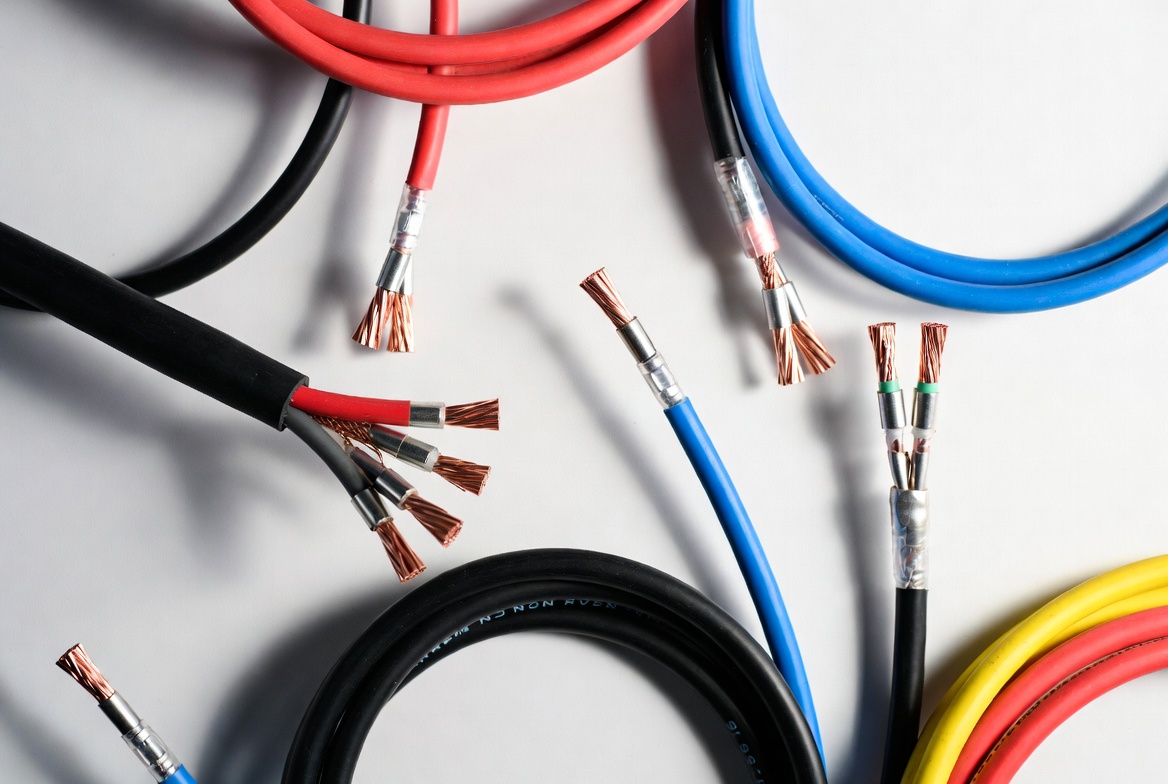
Cable Selection Guide
Professional Engineering Reference for Electrical Installations
Selecting the correct electrical cable is essential for ensuring safe, efficient, and reliable electrical systems. Incorrect cable sizing can lead to overheating, excessive voltage drop, energy losses, and potential equipment failure. This guide explains the key factors used by electrical professionals when selecting cables for residential, commercial, and industrial installations.
Determine the Electrical Load
The first step in cable selection is determining the current required by the electrical load. Accurate load current calculation ensures the cable can safely carry the electrical load without exceeding its thermal limit.
Load current depends on the equipment power rating, system voltage, power factor, and whether the system is single-phase or three-phase.
Current Calculation Formulas
Single Phase System
Current (A) = Power (W) ÷ Voltage (V)
Three Phase System
Current (A) = Power (W) ÷ (√3 × Voltage × Power Factor)
Select Cable Based on Ampacity
Ampacity refers to the maximum current a cable can safely carry without exceeding its temperature rating. It is the primary criterion for initial cable size selection.
- Conductor material — copper vs. aluminium
- Insulation type — PVC (70°C) vs. XLPE (90°C)
- Installation method — conduit, tray, buried, free air
- Ambient temperature — Nigeria’s 40°C standard requires derating
- Cable grouping — grouped cables dissipate heat less efficiently
Cable Size Quick Selection Table
The table below provides a general engineering reference for copper conductors used in standard electrical installations.
| Load Current (A) | Typical Copper Cable Size |
|---|---|
| 6 A | 1.0 mm² |
| 10 A | 1.5 mm² |
| 16 A | 2.5 mm² |
| 20 A | 2.5 mm² |
| 32 A | 4 mm² |
| 40 A | 6 mm² |
| 63 A | 10 mm² |
| 80 A | 16 mm² |
| 100 A | 25 mm² |
| 125 A | 35 mm² |
| 160 A | 50 mm² |
| 200 A | 70 mm² |
| 250 A | 95 mm² |
| 315 A | 120 mm² |
| 400 A | 185 mm² |
| 500 A | 240 mm² |
| 630 A | 300 mm² |
⚠ Important: Actual cable size must also account for installation conditions, ambient temperature, grouping factors, and voltage drop requirements. This table is a starting reference only.
Consider Voltage Drop
Voltage drop occurs when electrical energy is lost along the cable due to conductor resistance. Excessive voltage drop can cause reduced equipment performance, overheating, and inefficient power delivery. Longer cable runs require larger conductors to maintain acceptable voltage levels.
| Circuit Type | Maximum Recommended Voltage Drop |
|---|---|
| Lighting Circuits | 3% |
| Power Circuits | 5% |
Conductor Material Selection
Electrical cables are manufactured using copper or aluminium conductors. Each material has distinct characteristics that make it more suitable for different applications.
Copper Conductors
- Higher conductivity
- Lower resistance
- Smaller size required
- Building wiring
- Industrial installations
- Control circuits
Aluminium Conductors
- Lighter weight
- Lower material cost
- Large power distribution
- Utility feeders
- Underground distribution
- Overhead lines
Installation Conditions
Cable performance depends greatly on how and where it is installed. High temperatures or tightly grouped cables reduce the cable’s ability to dissipate heat, requiring ampacity derating.
- Cables installed in conduit or pipe
- Cables buried directly underground
- Cables supported on trays in industrial facilities
- Cables installed freely in open air
- Grouped cables in confined spaces
Environmental & Mechanical Considerations
Cable selection must account for the conditions the cable will face throughout its operating life. Proper insulation and protective sheathing ensure long service life and safety.
- Moisture exposure — wet or submerged environments
- Chemical exposure — industrial solvents, acids, or oils
- UV radiation — outdoor and rooftop installations
- Mechanical stress — crushing, vibration, or flexing loads
Cable Resistance Reference Table
Electrical resistance affects both voltage drop and heat generation in cables. The values below represent typical DC resistance at 20°C reference temperature, as specified by IEC 60228.
| Size (mm²) | Copper (Ω/km) | Aluminium (Ω/km) |
|---|---|---|
| 1.5 mm² | 12.10 | 20.40 |
| 2.5 mm² | 7.41 | 12.10 |
| 4 mm² | 4.61 | 7.41 |
| 6 mm² | 3.08 | 4.95 |
| 10 mm² | 1.83 | 3.08 |
| 16 mm² | 1.15 | 1.91 |
| 25 mm² | 0.727 | 1.20 |
| 35 mm² | 0.524 | 0.868 |
| 50 mm² | 0.387 | 0.641 |
| 70 mm² | 0.268 | 0.443 |
| 95 mm² | 0.193 | 0.320 |
| 120 mm² | 0.153 | 0.253 |
| 150 mm² | 0.124 | 0.206 |
| 185 mm² | 0.099 | 0.164 |
| 240 mm² | 0.075 | 0.125 |
| 300 mm² | 0.060 | 0.100 |
| 400 mm² | 0.047 | 0.077 |
| 500 mm² | 0.036 | 0.060 |
| 630 mm² | 0.028 | 0.047 |
Practical Examples of Cable Selection
Example 1
45 A
30 m
Single Phase
10 mm² Cu
Example 2
120 A
50 m
Three Phase
50 mm² Cu
Engineering Tools
Absolute Cablemart Ltd provides free online engineering tools to support accurate cable selection for electrical system design.
- Cable Size Calculator — determine correct conductor size from load and length
- Voltage Drop Calculator — verify compliance with voltage drop limits
- Cable Ampacity Chart — maximum current ratings for all standard sizes
- Cable Resistance Table — IEC 60228 resistance values for calculations
Cable Selection for Multi-Core Cables
Electrical installations often use multi-core cables, where two or more insulated conductors are contained within a single outer sheath. These cables simplify installation, reduce conduit requirements, and offer integrated mechanical protection.
| Cable Type | Typical Application |
|---|---|
| 2-Core Cable | Single-phase circuits (live and neutral) |
| 3-Core Cable | Single-phase with earth conductor |
| 3.5-Core Cable | Three-phase distribution with reduced neutral |
| 4-Core Cable | Three-phase + neutral systems |
| 5-Core Cable | Three-phase with separate earth conductor |
Effect of Multiple Cores on Current-Carrying Capacity
When several conductors are grouped within the same cable, heat dissipation is reduced, which lowers the allowable current capacity compared with single-core cables. Engineering standards recommend applying derating factors accordingly.
| Cable Type | Typical Ampacity Factor |
|---|---|
| Single Core | 1.00 (reference) |
| 2-Core Cable | 0.90 |
| 3-Core Cable | 0.85 |
| 4-Core Cable | 0.80 |
Worked Example: A single-core 50 mm² copper cable has an ampacity of 150 A. For a 4-core cable, the allowable current is 150 × 0.80 = 120 A.
Engineering Example — Three-Phase Motor Supply
Motor Supply Calculation
75 A
3-Core Cu
232 A
≈ 197 A
95 mm² 3C
When Multi-Core Cables Are Preferred
- Limited installation space
- Mechanical protection required
- Faster installation needed
- Cleaner cable routing desired
- Industrial motors & drives
- Underground feeders
Installation Methods & Their Impact
The installation method significantly affects a cable’s current-carrying capacity because it determines how effectively heat can dissipate from the conductor. Engineers must account for installation conditions during cable selection to prevent overheating and ensure safe operation.
| Installation Method | Description | Ampacity Factor |
|---|---|---|
| Free Air | Open installation with maximum heat dissipation | 1.00 |
| Cable Tray | Supported on trays in industrial facilities | 0.95 |
| Conduit | Installed inside protective conduit or pipe | 0.90 |
| Direct Buried | Cable installed directly underground in soil | 0.85 |
Worked Example: A cable rated at 200 A in free air installed in conduit has an allowable current of 200 × 0.90 = 180 A.
Practical Engineering Recommendation
Factors to consider in every cable selection decision
- Load current (A)
- Voltage drop limit
- Conductor material
- Installation method
- Ambient temperature
- Cable grouping
- Environmental conditions
- Regulatory compliance
Conclusion
Correct cable selection is essential for electrical safety, efficiency, and long-term system reliability. By evaluating load current, conductor material, voltage drop, installation conditions, and applicable engineering standards, professionals can ensure optimal cable performance throughout the life of any installation.
Following internationally recognised engineering practices — such as those referenced by the International Electrotechnical Commission — helps maintain the highest levels of safety and system performance on every project.
Need cables for your next project? Our technical team is available to assist with cable sizing, BOQ review, and specification verification — and responds within 24 hours.Contact Our Technical Team
Source: www.absolutecablemart.com.ng
All resistance values per IEC 60228. Ampacity values per IEC 60364. For engineering use only — all installations must be verified by a qualified electrical engineer.
Expert Insights – Powering Nigeria’s Electrical Solutions - Absolute Cablemart Limited
March 23, 2026[…] Cable Selection Guide — helps users choose the right cable based on application and load requirements […]