
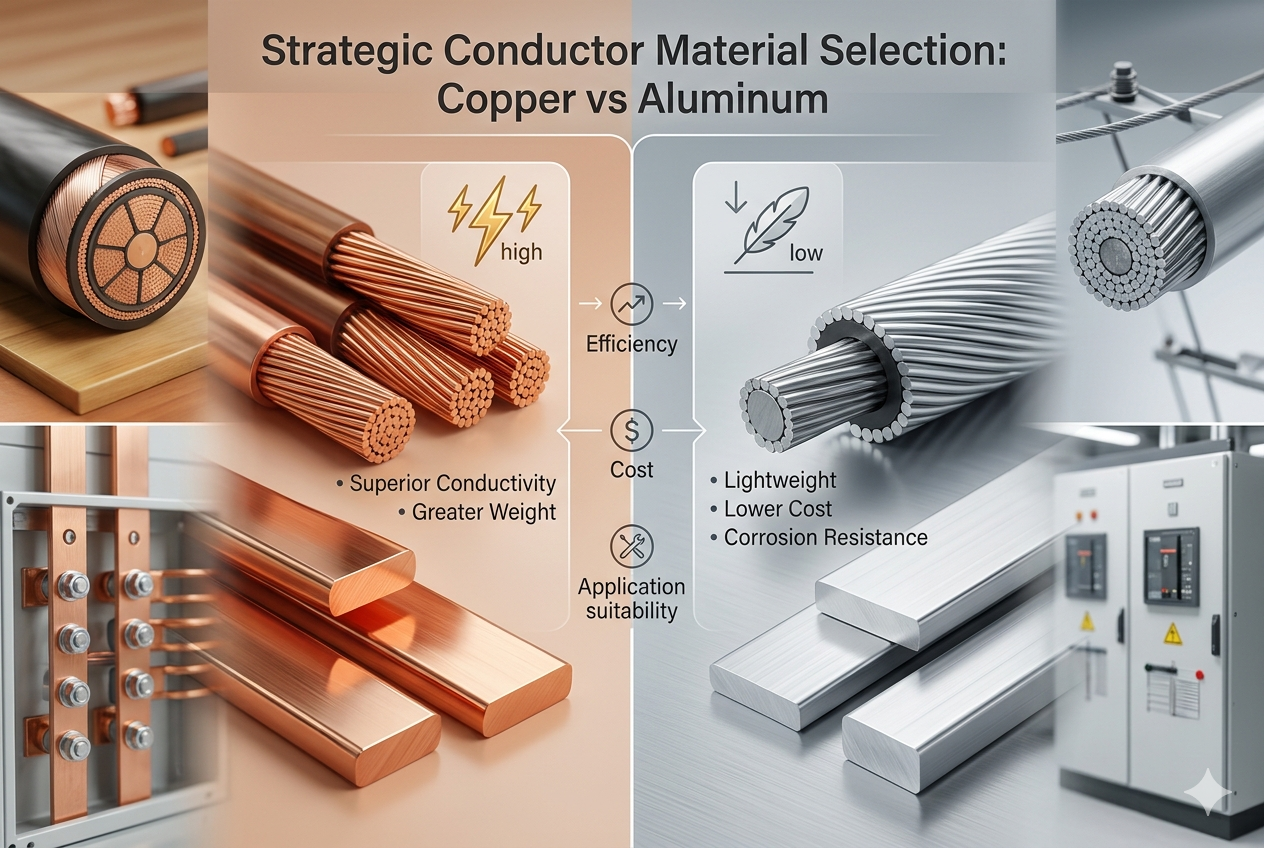
Strategic Conductor Material Selection: Copper vs Aluminum
Selecting the appropriate conductor material is one of the most important engineering decisions in electrical system design. The two most widely used materials for electrical conductors are copper and aluminum, each offering distinct advantages in terms of conductivity, weight, cost efficiency, and installation performance.
Electrical engineers must evaluate these materials carefully when designing power distribution systems, building wiring networks, transformer windings, and industrial electrical installations. Material selection directly affects current‑carrying capacity, voltage stability, installation cost, and long‑term system reliability.
Global conductor performance standards such as the IEC 60228 electrical conductor standard provide benchmarks for both copper and aluminum conductors used in electrical power cables. These standards define acceptable resistance values and conductor classifications to ensure safe and efficient electrical performance.
Electrical Conductivity and Performance
Copper is widely regarded as the benchmark material for electrical conductors because of its superior electrical conductivity. Pure electrolytic copper typically achieves 100% International Annealed Copper Standard (IACS) conductivity, allowing it to transmit electrical current efficiently with minimal resistance.
Aluminum conductors, commonly manufactured from EC‑grade aluminum alloys such as 1050 or 1070 series, typically achieve approximately 61% IACS conductivity. While aluminum has lower conductivity than copper, its significantly lower weight and cost make it an attractive alternative in certain large‑scale power distribution applications.
Because aluminum conductors have lower conductivity, they generally require a larger cross‑sectional area to carry the same current load as copper conductors.
| Property | Copper Conductors | Aluminum Conductors |
|---|---|---|
| Electrical Conductivity | ~100% IACS | ~61% IACS |
| Weight | Heavy | Approximately 30–40% lighter |
| Mechanical Strength | High | Moderate |
| Corrosion Resistance | Excellent | Good (requires proper termination) |
| Installation Cost | Higher | Lower |
| Typical Applications | Building wiring, magnet wire, control cables | Overhead power lines, large distribution cables |
Typical Engineering Applications
In most residential and commercial electrical installations in Nigeria, copper conductors remain the preferred material due to their high conductivity, mechanical durability, and compatibility with standard electrical connectors.
Common copper applications include:
- Residential building wiring
- Industrial control cables
- Transformer magnet wires
- Motor winding conductors
Aluminum conductors, however, are widely used in large‑scale power infrastructure because of their lower weight and reduced material cost. These properties make aluminum suitable for applications such as:
- Utility power distribution lines
- Long‑distance transmission systems
- Large industrial feeder cables
- Transformer aluminum foil windings
-
Material Selection in African Power Infrastructure
Across many African electrical infrastructure projects, aluminum conductors are frequently used in overhead power distribution systems because they reduce structural load on utility poles and transmission towers. Meanwhile, copper conductors remain the preferred choice for internal building wiring and precision electrical equipment due to their superior conductivity and reliability.
Electrical conductors supplied through Absolute Cablemart Ltd, including products manufactured by Nigerchin Limited and Zhengzhou LP Industry Co., Ltd, are designed to meet internationally recognized electrical engineering specifications. These materials are manufactured in compliance with standards established by the International Electrotechnical Commission and regulatory frameworks enforced by the Standards Organisation of Nigeria.
Key Considerations for Engineers
When selecting conductor materials, electrical engineers must evaluate several factors:
- Required current‑carrying capacity
- Installation environment and temperature conditions
- Cable weight and structural support requirements
- Project cost considerations
- Compliance with international electrical standards
Balancing these factors allows engineers to select conductor materials that provide optimal safety, efficiency, and long‑term reliability within electrical power systems.